Beyond Amazon Japan: 7 Niche Japanese Shopping Sites Worth Knowing in 2026
Amazon Japan, Rakuten, and Yahoo Auctions handle the majority of Japanese e-commerce volume, and for good reason — they're broad, reliable, and easy to use through a proxy. But they're also optimised for mainstream retail. The algorithm surfaces what sells in volume, not what's rare, handmade, or genuinely distinctive.
The platforms below sit outside that mainstream. Some are specialist retailers who source directly from craftspeople. Some are crowdfunding platforms where products don't exist anywhere else. One isn't a store at all but a tool that unlocks hundreds of Japanese sites that otherwise reject foreign cards. None of them are particularly well-known outside Japan, which is exactly what makes them worth knowing.
A note on proxy requirements: most of these sites don't offer international shipping or accept non-Japanese payment cards. Where that's the case, a Japan-based proxy service is the practical solution — the same services used for Mercari or Yahoo Auctions work for these platforms.
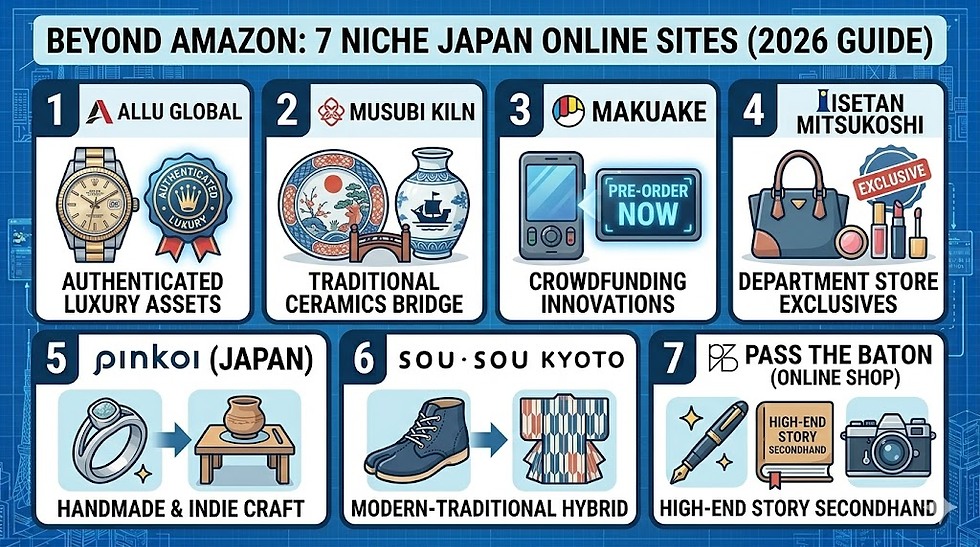
1. ALLU Global — Luxury vintage and high-value watches
ALLU is a Japanese luxury resale platform that owns its inventory outright rather than listing on behalf of private sellers. Every item — Rolex, Grand Seiko, designer leather goods, high-end jewellery — is inspected and authenticated by an in-house professional team before listing. This is a meaningful distinction from marketplace-style platforms where condition accuracy depends entirely on the individual seller's honesty and eye for detail.
The case for buying vintage Japanese luxury here rather than through European or US dealers comes down to how Japanese collectors maintain their possessions. Watches and bags sourced from Japanese collections consistently surface in better condition than comparable pieces from other markets — service records are often retained, original packaging is intact, and storage has been careful. ALLU captures the top end of that supply chain.
For high-value purchases, they offer fully insured international shipping with declared values — important for anything above ¥1,000,000 where standard postal insurance caps become inadequate.
Best for: Vintage Rolex, Grand Seiko, luxury leather goods, authenticated jewellery.
2. Musubi Kiln — Traditional Japanese ceramics and tableware
URL: musubikiln.com
Musubi Kiln sources directly from traditional kilns across Japan — Kutani, Arita, Mashiko, Mino — and sells internationally with English-language listings and international shipping already handled. This last point matters more than it sounds: the craftspeople producing these pieces are often small family operations with no export infrastructure and no English-language presence. Musubi Kiln acts as the bridge between that supply and overseas buyers who would otherwise have no route to it.
The product range covers everyday usable ceramics — plates, bowls, cups — as well as decorative pieces and lacquerware. If you've seen high-quality Japanese tableware in a restaurant and wanted to find where it came from, this is one of the most reliable sources.
One practical note: ceramics are dense and fragile, and international shipping costs reflect both. Musubi Kiln uses export-grade protective packaging specifically for international orders, which is worth knowing before comparing their shipping rates against a generic forwarder.
Best for: Kutani and Arita ceramics, lacquerware, Japanese tableware for everyday use or gifting.
3. Makuake — Japanese crowdfunding and first-edition products
URL: makuake.com
Makuake is Japan's leading crowdfunding platform for physical products. The model is similar to Kickstarter — you back a project before the product exists and receive it from the first production run — but the focus is specifically on Japanese makers, craftspeople, food producers, and hardware innovators.
What makes it interesting for overseas buyers is the nature of what gets funded here. Self-heating lunchboxes, limited sake runs from single-prefecture micro-breweries, new-generation tech accessories developed by small Japanese workshops, craft tools in limited first editions — these are products that often don't reach any other sales channel after the campaign closes. The first run is sometimes the only run.
Most project creators are small operations without international shipping infrastructure, so a proxy is necessary for the vast majority of campaigns. Most projects are structured as "keep it all" — meaning the campaign proceeds regardless of whether the funding target is met, so your backing isn't contingent on a goal being reached. Delivery timelines on Makuake, as with crowdfunding generally, should be treated as estimates rather than guarantees.
Best for: First-edition Japanese innovations, limited food and drink runs, craft tools, early-access hardware.
Note: because it is crowdfunding, the "Shipping Date" can sometimes be 6 months in the future. Beginners often expect Amazon-style speed, so a small "Patience Warning" there can prevent customer service headaches for you later.
4. Isetan Mitsukoshi — Department store exclusives and luxury retail
URLs: isetan.mistore.jp / norennoren.jp
Isetan Mitsukoshi is Japan's most prestigious department store group, and its online presence has expanded significantly as a channel for exclusives and curated retail. The "Isetan stamp" on a product functions as an authenticity signal in the Japanese market — the store's buying team is rigorous, and counterfeit goods don't reach their shelves.
For overseas buyers, the most practical interest is in the brand collaborations the store runs exclusively: Isetan-specific colourways and editions from Japanese labels like Undercover and BAPE, exclusive cosmetics sets and seasonal collections from high-end beauty brands, and curated gourmet items (wagashi, sake, pantry goods) that don't appear on other platforms.
The norennoren.jp site functions as the curated gifting portal — particularly useful for seasonal gifts, where the department store packaging is itself part of what you're buying.
Best for: Exclusive brand collaborations, authenticated luxury cosmetics, Japanese gourmet and seasonal gifting.
5. Pinkoi (Japan section) — Independent artists and custom work
Pinkoi is a pan-Asian marketplace for independent designers, and its Japan section specifically filters for Japanese creators. The range covers jewellery, ceramics, textile goods, leather accessories, and illustration-based products — most made in small quantities by individual artists or tiny studios.
The platform's interface is in English, accepts international payment, and many sellers ship internationally directly — which means it's one of the few entries on this list that doesn't require a proxy for most purchases.
The more interesting use case is direct creator contact. Many of the Tokyo and Kyoto-based artists on Pinkoi take custom orders — a specific metal, a personalised engraving, a colourway made to request — and respond in English. For something genuinely one-of-a-kind made by a specific person in Japan, this is a more direct route than any marketplace.
Best for: Handmade jewellery, custom ceramics, independent textile work, gifts with a specific origin story.
6. SOU·SOU Kyoto — Contemporary Kyoto textile and footwear
URL: sousou.co.jp
SOU·SOU is a Kyoto-based brand that works with traditional Japanese textile techniques and silhouettes — tabi split-toe footwear, kimono-influenced garments, hand-dyed fabrics — but applies them to contemporary everyday clothing.
The result is distinctive without being costume-like, which is why the brand has developed a following internationally among people who want Japanese craft and aesthetic in something they can actually wear.
The tabi sneakers are the best-known product outside Japan, and SOU·SOU collaborates regularly with other brands — Le Coq Sportif among them — producing items that don't exist anywhere else in the market. The website has international shipping and an English interface, and seasonal collections sell out in certain styles, so monitoring new arrivals is worth doing if there's a specific item you're after.
Best for: Tabi footwear, kimono-influenced contemporary clothing, Japanese textile accessories.
7. Pass the Baton (Online Shop)
URL: pass-the-baton.com
The Niche: High-end story-driven archives and "New-Cycle" collectibles. Why it’s a 2026
Must-Know: Following its major online relaunch in February 2026, Pass the Baton has become the destination for "Contextual Secondhand." Here, the history of the item is as important as the item itself. You’ll find things like a retired artisan's private tool collection or limited-edition deadstock from Kyoto textile mills reimagined into modern bags. It is the antithesis of "Fast Fashion."
Verifying a Japanese site before you buy
The less well-known a platform is, the more important it is to verify it's legitimate before entering payment details. Japan has a specific legal mechanism that makes this straightforward.
Any legitimate Japanese retailer is legally required to publish a 特定商取引法に基づく表記 (Specified Commercial Transactions Act disclosure) page. This lists the company's registered name, physical address in Japan, phone number, and representative's name. If a site doesn't have this page — or it's blank, incomplete, or shows a residential address with no company name — treat it with serious caution.
Two other quick checks: confirm you're on the official domain (copycat sites targeting Japanese retailers became more common in 2025–2026), and avoid any site that requests direct bank transfer (銀行振込) as the only payment option. Legitimate retailers accept credit cards or PayPal for most purchases; bank transfer as a sole option removes your ability to dispute the transaction if something goes wrong.
Site availability and shipping policies accurate as of April 2026. Japanese retail sites update international shipping options periodically — verify directly before ordering.


Comments